


Indoor AC rooms often feel dry, especially during the summer or winter cold. You may experience dry skin, a burning sensation in your throat, or static electricity. Many people wonder if indoor plants can naturally increase humidity in such environments. I had this same question after running the AC daily and watching my snake plant's soil dry out rapidly. Understanding the true scientific relationship between plants, transpiration, and AC systems helps you set realistic expectations and safely improve indoor comfort.
Quick Answer Box:
Related News



Yes, indoor plants increase humidity through transpiration, but the effect is minimal and limited in AC rooms.
• Plants naturally release moisture through their leaves.
• AC constantly removes humidity from the air.
• Some plants cannot offset the drying effect of AC.
• Several plants combined can slightly improve local humidity.
• Plants contribute to micro-humidity near their leaves, not throughout the room.
Plants help, but they can never replace a humidifier.
Science: How Indoor Plants Increase Humidity
Indoor plants increase humidity through a process called transpiration. This occurs when plants release water vapor through tiny pores in their leaves.
During transpiration:
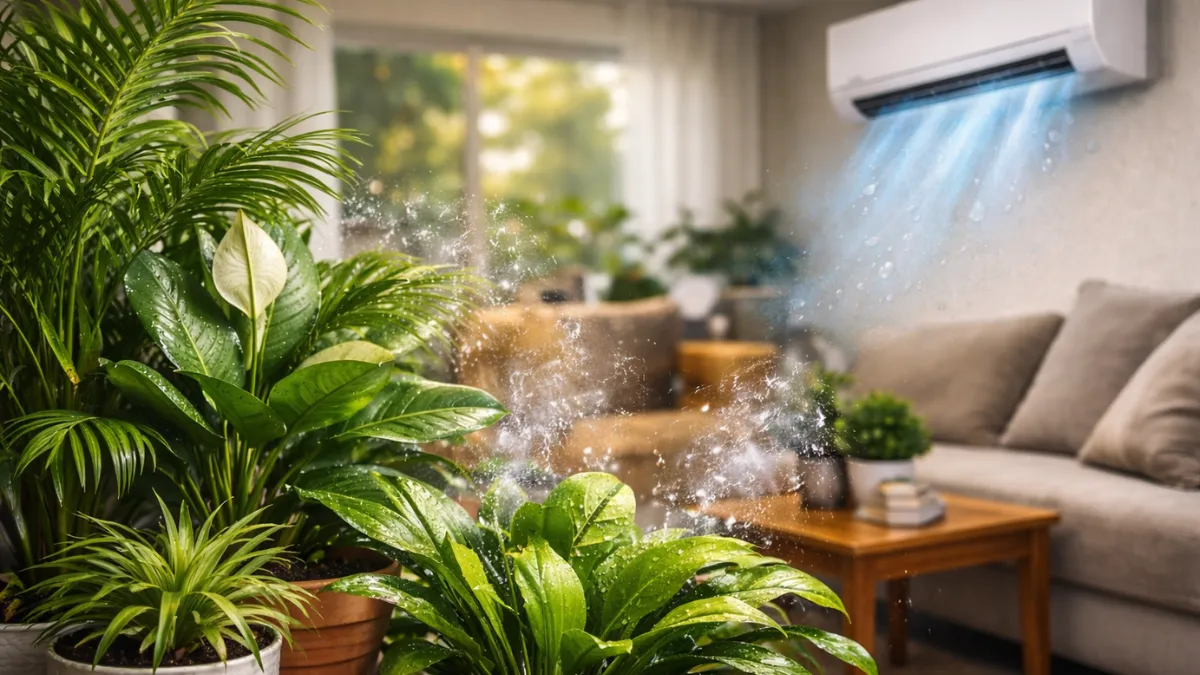
• Roots absorb water from the soil.
• Water passes through the plant tissue.
• Leaves release water vapor into the air.
This automatically increases the ambient humidity.
Many plant owners ask if indoor plants release moisture into the air in AC rooms, and scientifically, yes—they always do, whether the AC is in use or not.
However, the amount they release is slow and less than in mechanical systems.
Why do AC rooms feel dry despite plants?
Air conditioners remove moisture as part of their cooling. This happens because the AC coils condense water vapor and expel it.
This creates a continuous cycle of moisture removal.
So, even if plants release moisture, the AC removes it quickly.
This explains why indoor plants cannot completely release moisture in air-conditioned rooms.
The balance looks something like this:
| Factor | Effect on Humidity |
|---|---|
| Indoor plants | Increase slowly |
| AC system | Removes quickly |
| Large plant group | Slight increase |
| Small number of plants | Minimal effect |
AC systems are much more robust than plant transpiration.
Actual Measured Humidity Increase from Plants
Scientific experiments show that indoor plants can increase humidity by between 1% and 5%, depending on the number of plants and the size of the room.
The humidity effect depends on:
• Number of plants
• Leaf surface area
• Room size
• Ventilation
• AC runtime
Many people wonder how much humidity indoor plants actually add scientifically, and the answer is measurable but limited.
In small, enclosed spaces, the effect is more pronounced.
In large AC rooms, the effect is reduced.
Micro-humidity Effect : A Hidden Benefit
Plants create small zones of higher humidity around themselves. This is called a microclimate.
This means that the air near the plant's leaves contains more moisture than the room average.
This answers the question: Do plants create local humidity around them in AC rooms?
This helps:
• Reduce leaf dryness
• Improve plant health
• Some benefit to people nearby
But it doesn't create uniform humidity throughout the room.
The Best Indoor Plants That Release More Humidity
Plants with large leaves absorb more water.
Examples are:
• Areca Palm
• Peace Lily
• Boston Fern
• Rubber Plant
• Spider Plant
These plants release more moisture due to their large leaf area.
This explains which indoor plants increase humidity the most in an AC environment.
In my experience, my Areca Palm increased the ambient humidity slightly, but it had no effect on the entire AC room.
Why One or Two Plants Are Not Enough
A single plant releases very little moisture.
The increase in humidity is only noticeable when several plants are placed together.
This answers the question of how many plants are needed to increase humidity in an air-conditioned room.
Scientific estimates show:
• 5–10 plants = slight improvement
• 10–20 plants = noticeable micro-humidity
• 20+ plants = measurable effect on the room
Most homes don't have enough plants to fully humidify AC rooms.
What doesn't work well (real experience)
I once planted just one snake plant near my bed in hopes of improving humidity.
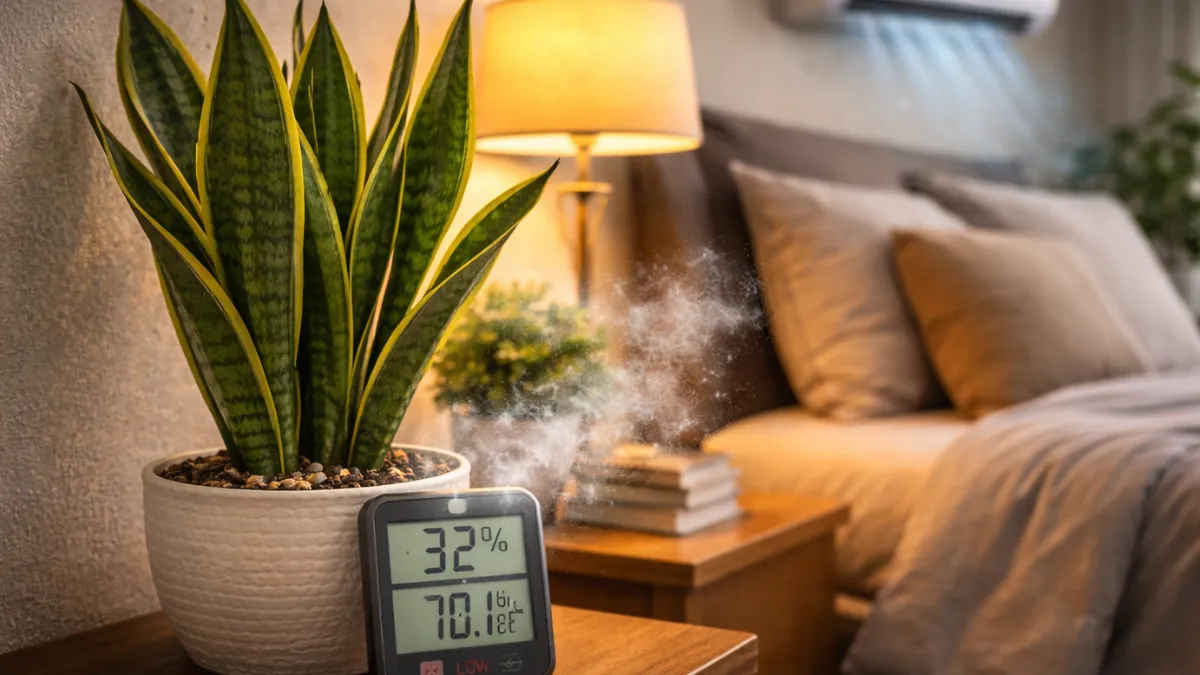
It didn't make any significant difference to the dryness.
This answers why a snake plant alone doesn't effectively increase humidity in an AC room.
Snake plants release less moisture because:
• Low transpiration rate
• Thick leaves conserve water
Plants help gradually, not immediately.
Drawbacks : Plants cannot replace humidifiers.
Plants release moisture slowly, while humidifiers release moisture quickly and in a controlled manner.
This explains whether indoor plants can replace humidifiers in air-conditioned rooms.
Plants help in:
• Slightly improving natural humidity
• Long-term comfort
But not enough to compensate for extreme dryness.
This is a significant drawback that many people misunderstand.
Benefits of Plants in Dry AC Rooms Beyond Humidity
Even if the humidity is slightly increased, plants also provide other benefits.
These include:
• A reduced sense of dryness in the air
• A better sense of comfort
• Improved indoor air quality
• Reduced stress and fatigue
Many plant owners notice that even when plants increase humidity slightly, the indoor air feels fresher.
This is partly psychological and partly due to the effect of microclimate.
The idea is clear : plants naturally add comfort to indoor spaces, but they aren't designed to act as primary humidity control devices.
The best strategy for improving humidity using plants
For best results:
• Use several medium-sized plants
• Plant plants in groups
• Space plants closely together
• Use broad-leaf varieties
• Avoid direct AC air on plants
This improves the micro-humidity effect.
This provides the answer to how to naturally increase humidity in AC rooms with indoor plants.
Grouping plants increases the effect of collective transpiration.
Scientific Comparison : Plants vs. Humidifiers
| Feature | Indoor Plants | Humidifier |
|---|---|---|
| Humidity increase speed | Slow | Fast |
| Coverage | Localized | Entire room |
| Control | Limited | Adjustable |
| Energy use | None | Requires electricity |
| Natural benefit | Yes | No biological benefits |
Plants naturally contribute, but humidifiers are more powerful.
Related articles:
Best Low Light Indoor Plants That Actually Survive (2026 Picks)
Related articles:
Temperature Shock in Indoor Plants : AC, Heater & Winter Damage
Final Scientific Verdict
Indoor plants scientifically increase humidity through transpiration. However, in AC rooms, the increase in humidity is limited because the AC constantly removes moisture.
Plants improve local humidity, comfort, and freshness of the air, but they cannot completely offset the drying effects of AC alone.
Using multiple plants gradually improves results.
For a significant increase in humidity, plants work best as supportive natural enhancers rather than as a primary humidifier.
Written from real indoor plant care experience for IndoorPlantify.