


Indoor plants have long been touted as natural air purifiers. From Snake Plants to Peace Lilies, numerous blogs and social media posts claim that certain plants can make indoor air healthier by removing toxins.
But in 2026, science tells a more balanced story.
Related News



Yes, plants do interact with the air and can remove certain pollutants. However, the notion that specific plants can completely purify your home's air is, to a large extent, a misconception.
In this article, we will discuss the actual science behind plants and air purification, what researchers have *actually* found, and how indoor plants truly impact your home environment.
The Origins of the Belief That Plants Purify Air
The belief that plants clean indoor air stems primarily from a famous NASA Clean Air Study conducted in 1989.
Also Read : Do Indoor Plants Really Purify Air? Myth vs Science
Also Read : How Many Plants Do You Need to Purify Air in a Room?
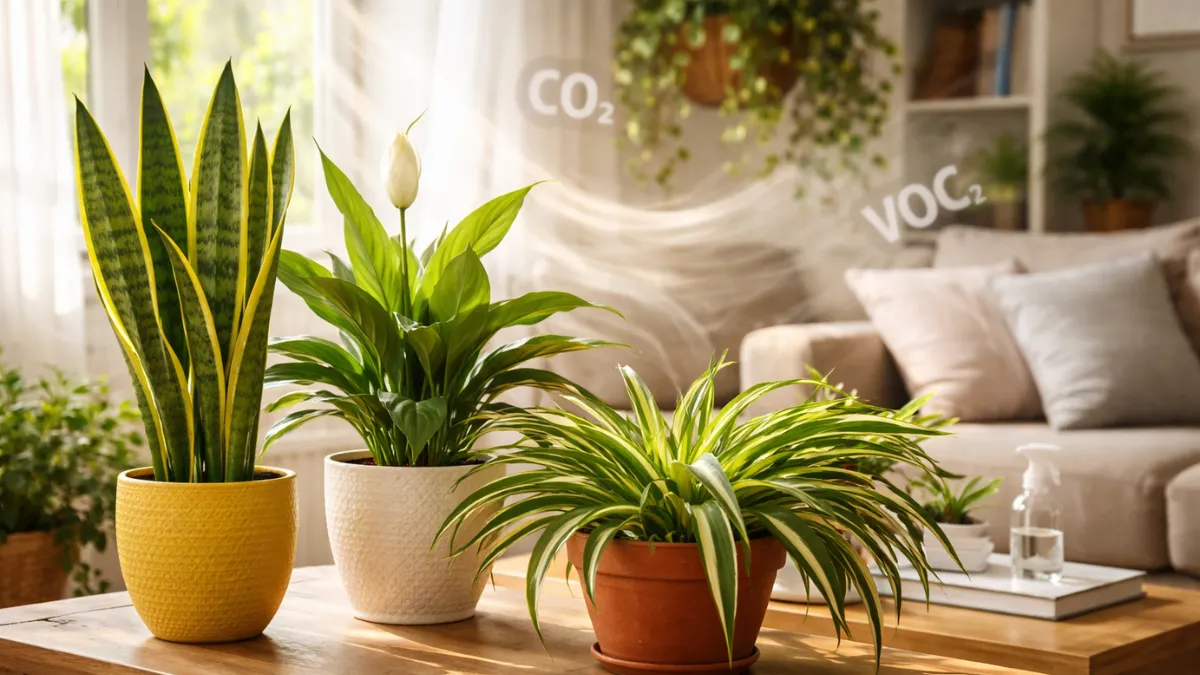
Scientists tested the following plants:
• Snake Plant
• Spider Plant
• Peace Lily
• English Ivy
They found that plants could remove certain chemicals such as benzene, formaldehyde, and trichloroethylene from sealed chambers.
This discovery spread rapidly across the internet and gardening communities, giving rise to this popular claim:
Houseplants naturally purify indoor air.
But there was one crucial detail that most people overlooked.
NASA's experiment was conducted in small, sealed laboratory chambers not in actual homes.
The Myth That Plants Purify Air: What Modern Science Says
Recent studies conducted by universities and environmental agencies have re-examined NASA's results.
The conclusion?
While plants do remove pollutants, their impact in typical homes is negligible. Researchers estimate that hundreds of plants would be required in a single room to achieve purification levels equivalent to standard ventilation.
This implies:
• Plants offer some minor assistance.
• However, they are not a substitute for ventilation.
• Nor are they a substitute for air purifiers.
Therefore, the notion that 2–3 plants can purify an entire room is essentially a myth.
Do plants improve indoor air quality?
Plants can influence indoor air in several ways:
1. Carbon Dioxide Absorption
During photosynthesis, plants absorb carbon dioxide (CO₂) and release oxygen.
However, the quantity absorbed by typical houseplants is so negligible that it results in no significant alteration to the composition of the indoor air.
2. Air Purification via Microorganisms
The soil surrounding plant roots contains microorganisms capable of breaking down certain pollutants.
This process is known as phytoremediation.
Yet again, within a standard home environment, the impact of this process is extremely limited.
3. Moisture Balance
Plants release moisture through transpiration, which can slightly elevate indoor humidity levels.
Increased humidity can sometimes make the air feel fresher and more comfortable.
Do green leaves purify indoor air?
Technically, yes. leaves can trap small particles such as dust.
The surface of the leaves acts as a natural filter where these particles accumulate.
However, this occurs on a very minute scale.
It is primarily regular cleaning, ventilation, and filtration systems that purify the bulk of the air inside our homes.
How many plants are needed to purify the air for a single person?
This question is frequently asked online. According to estimates in environmental engineering:
To match the air-cleaning rate of a typical building's ventilation system, you would need approximately 100–1,000 plants for every 10 square meters.
Obviously, this is not feasible for most households.
A typical living room might contain:
• 3 to 10 plants
Which means that, compared to open windows or air purifiers, their impact on air purification is quite negligible.

Also Read : Best Air Purifying Indoor Plants for Home – Science Based Benefits
Also Read : Best Air Purifying Indoor Plants (Science-Based List 2026)
Do indoor plants improve your mood?
This is where the true value of indoor plants comes to light.
Although their capacity to purify the air is limited, research strongly supports their psychological benefits.
Studies indicate that indoor plants can:
• Reduce stress
• Improve mood
• Boost productivity
• Enhance concentration
• Make spaces feel more comfortable
This phenomenon is known as biophilia the human tendency to feel better when surrounded by nature.
In offices, classrooms, and homes, plants often boost levels of satisfaction and reduce stress.
Do indoor plants improve air quality? A Reddit discussion
If you browse through gardening or plant-related communities on Reddit, you will encounter two common viewpoints:
Group 1:
Plants clean the air and remove toxins.
Group 2:
Plants do not purify the air in any meaningful way.
In reality, the truth lies somewhere between these two extremes.
Plants do interact with the air, but their impact is so minimal that they cannot dramatically purify a room.
Many Reddit discussions now cite modern environmental studies that validate this balanced perspective.
How Plants Purify the Air (A Simple Explanation for Children)
For young children (grades 2–4), this process can be explained in simple terms:
Plants purify the air through photosynthesis.
During photosynthesis:
1.Plants absorb carbon dioxide from the air.
2.They use sunlight and water to create food.
3.They release oxygen back into the air.
Leaves also trap tiny dust particles, helping to keep the environment slightly cleaner.
Why Do People Still Believe the Air Purification Claim?
This myth persists for several reasons:
Marketing
Plant brands and home decor companies often market plants as natural air purifiers.
Misinterpretation of NASA Studies
Many articles cite NASA research without explaining that the studies were conducted under sealed laboratory conditions.
Social Media
Pinterest, Instagram, and TikTok often repeat oversimplified facts about plants that spread rapidly online.
While plants do offer benefits, the claim regarding air purification is often exaggerated.
The Real Reasons to Keep Plants Indoors
Even if plants don't significantly purify the air, they still offer numerous benefits.
Aesthetics
Plants make rooms feel vibrant and cozy.
Mental Health Benefits
A lush, green environment helps reduce stress and boosts mood.
Home Decor
Plants enhance the beauty of minimalist homes, workspaces, and bedrooms.
Micro-environment Balance
They slightly increase humidity levels and help alleviate dry indoor air.
The Best Plants for Indoor Spaces
While these plants may not be able to replace air purifiers, they are still excellent additions to any home:
• Snake Plant
• ZZ Plant
• Spider Plant
• Peace Lily
• Areca Palm
• Pothos
They are popular because they are easy to care for, aesthetically pleasing, and adapt easily to indoor environments.
The Verdict: Myth vs. Science
So, do indoor plants actually purify the air?
The scientific answer is:
Partly true, but mostly exaggerated.
Plants can:
• Absorb small amounts of pollutants
• Trap dust particles
• Release oxygen
However, they cannot, on their own, significantly purify indoor air.
Nevertheless, they remain one of the best ways to enhance mood, aesthetics, and our connection with nature within the home.
So, even if plants aren't powerful air filters, they remain incredibly valuable companions for creating healthy living spaces.
Written for IndoorPlantify, based on personal, real-world experience with indoor plant care.